
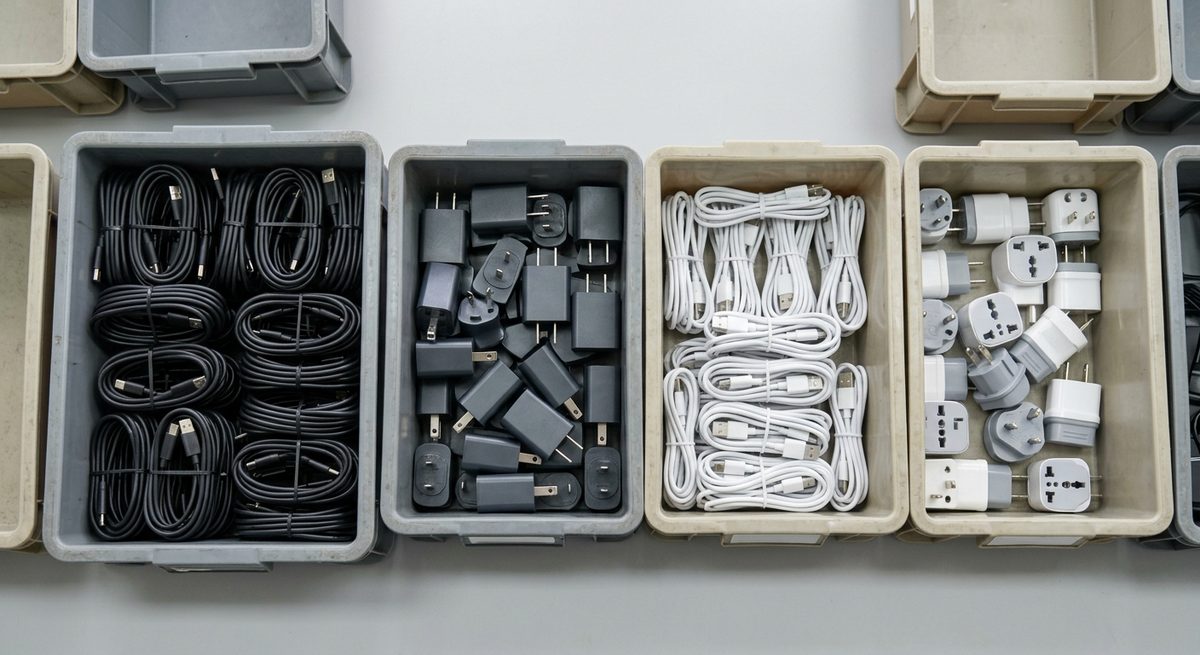
A buyer once sent us a photo of two cables from the same product line, cut open side by side. One had four honest copper conductors. The other, from a reorder placed at a lower price months later, was missing its data wires entirely, and its power conductors were copper-clad aluminium. The outer jacket gave nothing away. That photo is most of what you need to understand before you import USB cables from China: the problems hide inside the jacket, inside the plug or inside the charger housing, and they surface after the goods have sailed. Never before.
Cables and chargers look simple, and the entry price reflects that. The failure modes aren’t simple at all. What follows are the ones we meet most often across orders from Dongguan cable factories and Shenzhen charger plants, and the habits that stop each one reaching your warehouse.
It Charges, But the Laptop Sees Nothing
The classic complaint. A customer plugs in, the phone charges, and the computer never detects the device. Usually that’s a specification gap rather than a defect. Charge-only cables omit the data conductors to save copper, and if your purchase order never said data transfer, the factory quoted the cheaper build in good faith. USB-C stacks another layer on top: cables meant to carry higher power need an e-marker chip in the plug, and fast charging works when cable, charger and phone all agree with each other. Write the intended function into the spec in plain words. Charging, data, wattage, protocol. A one-line product name on an invoice protects nobody.
Copper, or Something Shaped Like Copper
Conductor material is where cable budgets get quietly trimmed. Copper-clad aluminium looks identical from outside, costs less, and carries higher resistance, which your customers experience as slow charging and cables that run warm. Thin gauge wire does the same job on the price and the same damage to the product. You can’t catch either by looking at a finished cable. You can catch both easily if you plan for it. A cut-open test on randomly picked units, a resistance measurement against an agreed maximum, and a signed sample kept from the approved pre-production run give an inspector something objective to hold the goods against. Quite often the difference between a clean order and a flood of complaints is one contract line stating pure copper and the wire gauge.
Connectors Give Up Long After the Inspection
A connector fault is the cruellest kind because it passes every test on shipping day. Thin gold plating wears through after weeks of daily use. Strain relief that’s too soft lets the joint flex until a conductor snaps. Cheap shells loosen and wobble in the port. The countermeasures all live at the factory: plating thickness on the component spec, an insertion-cycle test on the approval sample, and a swing test where the cable gets flexed under load a stated number of times. Walk through a good Dongguan cable plant and you’ll hear the swing-test rigs before you see them, a room of little arms clacking away all day like a hall of metronomes. Ask for the report with your batch number on it, not a generic certificate.
A Charger Is a Safety Product
A failed cable annoys a customer. A failed charger can overheat, and mains voltage sits a few millimetres of board space away from the USB port your customer’s child touches. That’s why chargers deserve more caution than any other small accessory, and it’s my firm view that this is the one place in the category where saving money is a bad trade. The Shenzhen charger cluster produces everything from excellent to alarming, sometimes in buildings on the same street. What separates them is invisible from outside: real isolation between the mains side and the USB side, real fuses, solder joints that hold, housings in flame-retardant plastic rather than lookalike material. Insist on genuine test reports from a recognised laboratory for your destination market, and have the report verified with the lab that issued it. We do that checking as part of our sourcing work, and it’s one of the strongest arguments for having help in Guangzhou before the order is placed rather than after a problem appears.
When the Goods Are Fine and the Order Still Goes Wrong
Plenty of cable and charger headaches are logistics problems wearing a disguise:
- Mixed lengths in one carton, because one metre and two metre cables share the same inner box design.
- A logo printed on the wrong face of the plug, or in a tone that misses the approved artwork.
- Retail blister packs crushed inside export cartons that were sized for bulk packing.
- Plug types for the wrong region, packed against an outdated order revision.
- Cables and chargers from two factories arriving on different dates and both missing the sailing.
That last one matters more than it looks. Cables commonly come from Dongguan and chargers from Shenzhen, and a retail set needs both in one place, kitted and repacked, before anything ships. Our consolidation and export handling exists for exactly this: goods from several factories meet at our warehouse, get checked and combined, and leave as one clean shipment with one set of documents.
The Routine That Makes Shipments Boring
None of the fixes above are exotic. What they need is sequence. Approve a golden sample and seal two of them, one for you and one for the inspection team. Put conductor material, wire gauge, plating, test standards and packing into the purchase order in writing. Inspect during production as well as at the end, because a fault found mid-run can still be corrected cheaply. At final inspection, pick random cartons and cut cables open. Then keep the records, so the reorder gets held to the same standard as the first order, which is precisely where that opening photo came from. Buyers who import USB cables from China on this routine tend to have uneventful shipments. Uneventful is the goal.
Cable and Charger Questions from Importers
Can an inspection really detect copper-clad aluminium conductors?
Yes. Cut-open checks show the silvery aluminium core under the copper skin, and a resistance measurement over a known length makes the difference measurable. Both take minutes once they’re written into the inspection plan, which is why they should always be in it.
What testing do chargers usually need for Western markets?
Most destinations expect safety and electromagnetic compatibility testing against their own recognised standards, shown through reports from an accredited laboratory. The exact scheme depends on the market, so confirm requirements for your country early and have your compliance advisor read the reports before production starts.
Is it better to buy cables and chargers from one factory?
Usually not. The two products need different equipment and different strengths, so the common setup is a cable maker in Dongguan and a charger maker in Shenzhen, with consolidation bringing the goods together. Specialists beat one factory stretching to cover both, on quality and usually on price too.
If a cable or charger order is sitting on your desk, get in touch through the contact form or WhatsApp. We’re based in Guangzhou, a short drive from both supply clusters, and we’re glad to host you here, take you into the factories in person, and run the checks that keep these small products from causing large problems.
Read next
Read next
What a Power Bank Really Costs: From Unit Price to Landed Cost
What drives the price when you import power banks from China: cells, boards, casing, certification and freight, stacked into…

CCTV Camera Imports: Testing and Paperwork Buyers Should Know
Plan to import CCTV cameras from China with confidence: common test marks, IP ratings, sample checks and export documents…
Electronics in Guangzhou: QC Risks and Golden Rules
Electronics sourced from Guangzhou and neighbouring Shenzhen have powered global supply chains for decades. The region is…