
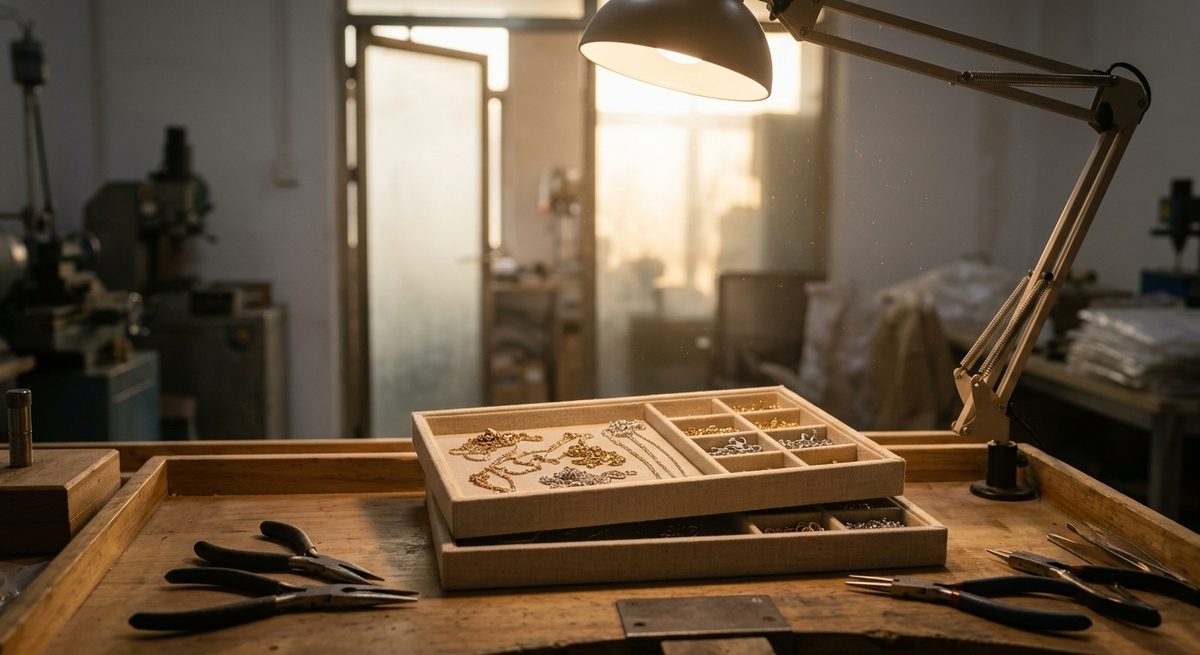
Take the metro south to Panyu on a weekday morning and you’ll share the carriage with people carrying small locked cases. Nobody discusses what’s inside. This corner of Guangzhou has been working metal for decades, originally for fine jewelry houses across the border in Hong Kong SAR, and the habits of that older trade still shape how fashion pieces get made here. So if you plan to import fashion jewelry from China, the first thing to understand is that you’re rarely buying from one factory. You’re buying from a district.
One address on the invoice, five workshops behind it
The supplier who quotes you is usually the assembler and the salesroom. Behind that company sits a web of specialists. A casting house pours the metal. A separate plating shop handles the gold, rhodium or gunmetal finish. Stone setting often goes out to small family workshops, sometimes literally a living room with good lamps. Then everything comes back for polishing, quality sorting and carding.
This isn’t a weakness. It’s how the district keeps prices sane. A dedicated plating line is expensive to run, so one plating shop serves thirty brands. What it does mean is that your lead time depends on five schedules, not one, and a delay at any single stage ripples down the chain. We plan orders around that reality rather than pretending it away.
Where a piece is actually born
Most fashion pieces start life as a wax. The casting house takes your approved model, builds a tree of wax copies, invests it in plaster and pours brass or zinc alloy into the cavity. Brass takes plating better and feels heavier in the hand. Zinc alloy is cheaper and fine for chunky statement pieces, though thin sections can snap. Which alloy you pick changes the price, the weight, and how the piece survives a year of wear.
Ask your supplier which casting house they use and how long they’ve used it. A long relationship there matters more than a smart showroom. Porosity, those tiny pinholes in cast metal, gets caught or missed at this stage and no amount of plating hides it later.
The plating shop announces itself before you see it
Walk down certain lanes in Panyu and you’ll know a plating shop is near from the smell alone. The rinse tanks give the corridor a sharp, swimming-pool edge that sits at the back of your throat. Inside, racks of rings and earring hooks dip in and out of the baths on timed hoists, and the whole room hums.
Plating is where fashion jewelry orders live or die. Three things need pinning down in writing:
- Plating thickness in microns, agreed per finish, not “good plating” as a vague promise.
- Whether the bath chemistry meets the nickel and cadmium limits of your market. European buyers should raise this on day one, since compliant baths commonly cost more.
- Salt spray or wear testing on pre-production samples, so you learn how the finish ages before three thousand units exist.
Cheap quotes usually hide here. A flash of gold measured in fractions of a micron looks identical in photos and turns dull on a customer’s skin within weeks.
Stones, chains and the component markets
Glass stones, resin pearls, cubic zirconia, chain by the metre, clasps by the kilogram: the components trade around Guangzhou is its own ecosystem, with wholesale floors where you buy findings the way other people buy vegetables. Suppliers mix and match from these markets, which is why two vendors can show you nearly identical earrings at different prices. One used a better clasp. You’d never spot it from a picture.
For buyers building a label rather than reselling generic designs, this is where the fun starts. Custom stone colors, logo-stamped tags and your own clasp tooling are all reachable at wholesale quantities. Plenty of our clients start with open designs and gradually make the range their own, and we build your own brand with our team step by step, from packaging to the stamped logo on the back of a pendant.
Running one order across the whole district
Here’s roughly how we manage it from our side in Guangzhou. We confirm the alloy and plating spec first, because those two decisions set the cost floor. Samples get worn, not just photographed. Someone in our office genuinely wears the earrings for two weeks. Then production is booked with dates for each stage, and we visit the assembler mid-run rather than waiting for the end, since a plating problem found early is a re-dip, while the same problem found at packing is a disaster.
Final inspection covers plating color consistency across the batch, clasp function, stone security and card presentation. After that the goods move into our warehouse, where jewelry from one or several suppliers gets combined into a single shipment. Our consolidation and export handling matters more in this category than most, because jewelry cartons are small, and shipping three tiny boxes separately by courier can cost more than the goods.
What I’d tell a first-time jewelry buyer
Start narrower than you want to. Ten strong designs in two finishes beat forty designs in five finishes, because every extra plating color multiplies your minimums and your inspection work. Put your budget into plating thickness before packaging. And come see Panyu if you can. An afternoon walking the district teaches you more about pricing than a month of chat messages, and suppliers quote differently once they’ve sat across a table from you.
Questions buyers keep asking about jewelry orders
Is hypoallergenic plating realistic at fashion price points?
Yes, with caveats. Nickel-safe baths and steel or titanium ear posts are standard options in Panyu now, and the upcharge is usually modest at wholesale volume. What you can’t do is assume it. Specify it, pay the small difference, and test a sample, because the default bath in many shops is chosen for cost.
Why did my quote jump when I added a second plating color?
Because it’s effectively a second production run. The plating shop racks and dips each finish separately, minimums apply per color, and the assembler now manages two batches through polishing and packing. Two colors on one design can cost more to organize than two designs in one color.
Can a single supplier handle rings, necklaces and hair accessories together?
Usually yes, since assemblers pull from the same district network for all of it. Quality can wobble on the edges of their comfort zone though. A vendor superb at cast rings may be average at fine chain work. We often split a collection across two or three workshops and consolidate everything before shipping.
If you’re weighing up a jewelry line and want eyes on the actual workshops, talk to us. We’re based in Guangzhou, a short drive from Panyu, and we host buyers in person: airport pickup, an interpreter, and factory visits where you can hold the castings yourself. Send a message through the contact form or WhatsApp and tell us what you want to make.
Read next
Read next
Cartons, Kilograms and Containers: Shipping Jeans from Xintang
Import jeans from China without freight surprises. Carton weights, container loading, moisture control and shipping modes…
The Guangdong Knitwear Map Behind Every Pair of Leggings
Learn where to import activewear from China. We map the Guangzhou and Dongguan knit belt, from fabric mills to cut and sew…
A Backpack Order from Guangzhou, Traced from Enquiry to Delivery
Follow a real order path to import backpacks from China: enquiry, sampling in Baiyun, price confirmation, production checks…