
Two importers can buy the same stainless steel bottle from neighbouring workshops in Guangzhou and land it at home at wildly different prices. The factory quote is only the opening line. Real import costs from China stack up in layers, and buyers who price their goods off the top layer alone meet the rest of the stack later, usually at the port, usually at the worst possible moment. Build the whole stack before you order and nothing at the port can ambush you.
First, ask what the quote actually includes
Check the trade term before you check the number. An EXW price covers the goods at the factory gate and nothing else. No transport to port, no export clearance, no loading. An FOB price includes local trucking, export formalities and delivery onto the vessel at a named Chinese port. Two factories can look far apart on price simply because one quoted EXW and the other FOB, so drag every quote onto the same term before comparing, and get what’s included confirmed in writing, right down to the export carton.
Read the small print inside the quote as well. Packaging specification, accessory contents, printing, material grade. A price that looks generous sometimes describes a thinner steel, a smaller gift box or a duller finish than the sample you held in your hand.
The stack, layer by layer
From the factory gate to your warehouse shelf, the usual layers run like this:
- Product cost at the agreed trade term, EXW or FOB
- Inland haulage and export handling, if the term doesn’t already cover them
- Ocean or air freight to your destination port or airport
- Cargo insurance for the journey
- Destination port or terminal charges and customs brokerage fees
- Import duty and import taxes assessed by your country
- Delivery from the port to your warehouse or fulfilment centre
- The supporting cast: samples, product testing, inspection, bank and currency fees
Spread all of that across the units in the shipment and you get the only number that matters: landed cost per unit. Price from that. Never from the quote.
Freight refuses to sit still
Freight is the twitchiest layer in the stack. Ocean rates move with the seasons, with fuel and with demand for space, so a rate quoted in spring is a rough guide for an autumn shipment and nothing more. The shape of your shipment matters as much as the rate. A full container buys you a fixed cost for a known space. Smaller consignments travel as LCL, sharing a container with other cargo, charged by volume and wrapped in handling fees at both ends that catch first-time buyers out. Air freight is fast, and it’s charged on actual weight or volumetric weight, whichever is greater, which punishes light but bulky goods.
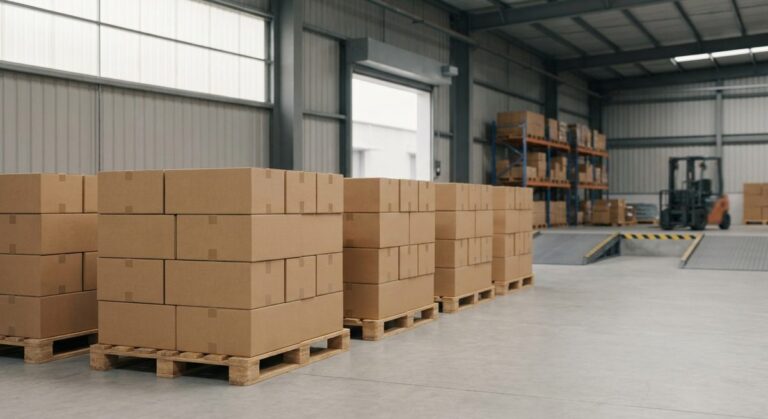
Buying from more than one factory changes the sums again. Shipping three small consignments separately out of Guangzhou, Foshan and Dongguan almost always costs more than trucking everything to one warehouse and loading it together. That’s where consolidation and export handling earns its keep: one combined shipment, one set of documents, one delivery at your end. I’ve stood in that warehouse while the tally clerk chalked carton counts straight onto the concrete floor, three suppliers’ boxes becoming one clean stack for the container. That stack is money saved.
The quiet lines nobody budgets
Several small costs are missing from most first spreadsheets, and together they aren’t small. Samples and courier fees arrive before the order does. A pre-shipment inspection is a modest line that protects the entire shipment, and I’d never skip it, whatever the budget says. Testing and certification apply to plenty of categories, from electronics to toys, and the laboratory fees cost time as well as money. Banks and currency platforms clip every transfer, and the exchange rate on the day you pay the balance can differ from the rate you budgeted at. Goods that wait anywhere start earning storage charges. None of these lines kills a project on its own. Ignored together, they quietly eat the margin you thought you had.
Duty lives and dies on the tariff code
Every product entering your country is classified under a tariff code, and that code decides the duty and tax treatment. Small differences in classification can mean real money, and the correct declaration is your responsibility as the importer. You won’t find duty percentages in anything we write, and that’s deliberate: rates vary by country and by product, and they change. The reliable route is dull and short. Give your customs broker a precise product description, a materials list and the intended use, have them confirm the code and the current rate in writing, and put that figure into the landed cost before you order. Update it whenever the specification changes.
The worksheet, and the small choices that move it
Build a simple spreadsheet. One row per cost layer, one column per product. Fill it in like a pessimist: round freight up, include the inspection, assume the slower sailing. Divide by units. Stare at the result. On the ground, small physical choices shift this number more than negotiation ever does. A carton redesigned to sit properly on a pallet. A packaging tweak that stops you paying to ship air. A supplier in Foshan chosen over an equal one much further inland. Buyers who want help in Guangzhou with exactly this kind of tuning usually find the savings cover the support several times over.
The landed cost questions we hear most
Why did my small LCL shipment cost so much per cubic metre?
Because LCL carries fixed handling charges at origin and destination that don’t shrink with the shipment. On a tiny consignment those fees dominate, so the effective rate per cubic metre looks painful. It improves sharply as you grow toward a full container, which is one more argument for consolidating purchases into fewer, larger shipments.
Should I ask factories for EXW or FOB prices?
For comparing suppliers, FOB at a named port is the cleaner benchmark, because it bakes in each factory’s own local logistics and export handling. If an agent or forwarder is collecting goods from several factories for consolidation anyway, EXW can suit better. Whichever you pick, hold one term across every quote you compare.
Do import costs from China fall at bigger order quantities?
Commonly yes, through three doors at once. Factories sharpen unit prices at volume, a full container beats LCL per cubic metre, and fixed costs such as inspection and documentation spread across more units. How much varies by factory and product, so model your realistic next order, not a fantasy volume.
Want your landed cost checked by people who see these numbers every week? Send it over through the contact form or WhatsApp. We’re based in Guangzhou, we meet buyers in person, and we walk clients through factories in Foshan, Dongguan and beyond, so the price you calculate is the price you actually pay.
Read next
Read next
How to Import from China: A Step by Step Buyer Guide
How to import from China, step by step: specs, supplier checks, samples, inspections and freight, told by a sourcing team…

What a China Agent Actually Does for a Wholesale Buyer
What a China agent really does all week for wholesale buyers: factory visits, negotiation, quality checks and export work…
Choosing Products to Import from China: A Working Method
Choosing products to import from China starts with honest margin maths. How unit cost, freight and MOQ decide whether a…