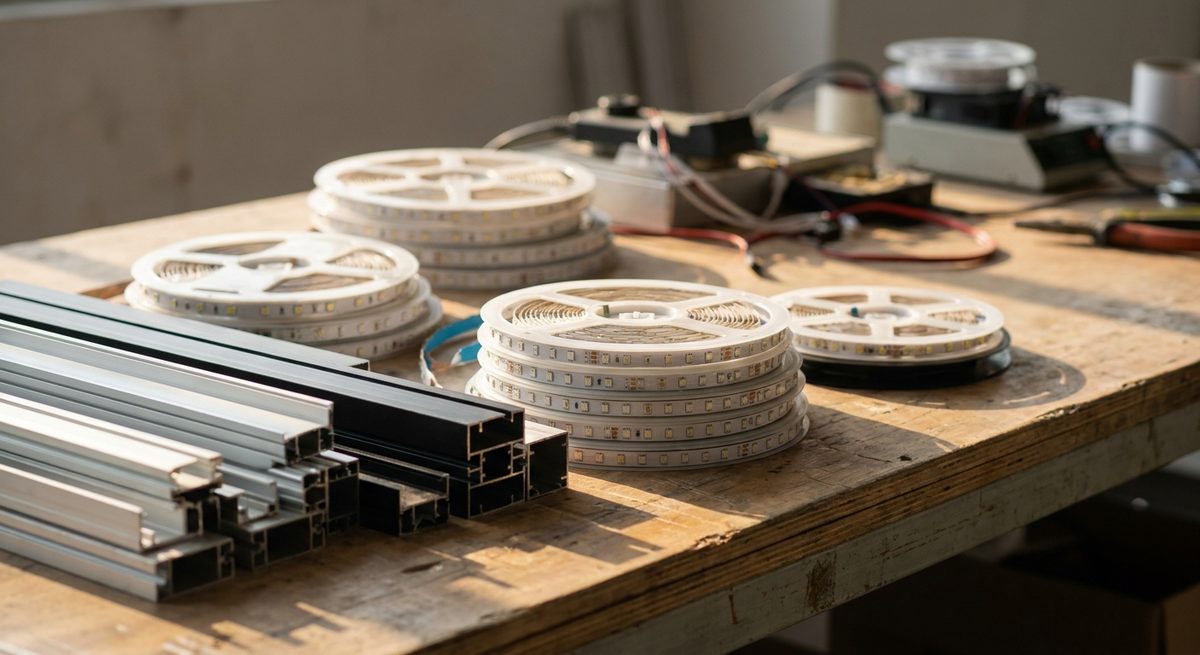
Last autumn a lighting wholesaler wrote to us with a one line enquiry: warm white strips, waterproof, good price. Six emails later we finally had a real specification, and only then did any quotation mean anything. That exchange repeats itself constantly. An LED strip looks like a simple product and it isn’t, so if you plan to import LED strip lights from China, the quality of your order is set on the first page, the spec sheet, and everything after, sampling, production, testing, shipping, flows from it. Here’s how one order actually moves from enquiry to delivery.
A spec sheet a factory can actually quote
“5 metre LED strip” describes thousands of different products at wildly different prices. A quotable spec pins down at least this much:
- Chip package and count, 2835 or 5050 for example, and LEDs per metre.
- Working voltage, commonly 12V or 24V for constant voltage strips.
- Colour temperature and the tolerance you’ll accept, plus CRI if colour rendering matters in your market.
- Ingress protection: bare board, coated, or fully sleeved for damp locations.
- PCB width and copper weight, which decide how the strip sheds heat over long runs.
- Reel length, connector type, adhesive brand and packaging format.
Two quotations that differ sharply in price usually differ somewhere in that list. Find where. Once the sheet is fixed, every factory is pricing the same product and comparison finally becomes honest.
Where the shortlist comes from
Most of the strip lighting we buy traces back to Guzhen in Zhongshan, a town about an hour and a half from Guangzhou that has organised itself almost entirely around lighting. Strip makers, aluminium profile extruders, diffuser suppliers and packaging printers sit within a few streets of each other. The drivers and controllers usually come from Shenzhen instead, where the smart lighting and wireless control people are. We’d normally shortlist three to five factories matched to your volume, because a plant tooled for huge commodity runs treats a mid-size custom order very differently than a smaller specialist does. This is the stage where a China sourcing agent in Guangzhou saves you the most time. We already know which Guzhen lines run the chip brands and coating processes a given spec calls for, and we can drive out and audit a new candidate within a day.
Samples that tell the truth
Paper agreed, samples next. The aim is to make the sample stage predictive rather than decorative, so we ask factories for full reels, not short offcuts, cut from the same line and materials they quoted for production. Then the client tests them the hard way: brightness against the datasheet, colour consistency along the full length and between reels, how the adhesive grips the surfaces their customers actually mount on, and how warm the strip runs inside an aluminium profile after a few hours. A sample that passes a five minute desk glance and fails a weekend in a display cabinet has done you no favours. Budget two or three sample rounds for a custom spec. First-round approval happens, but planning for it is optimism, not scheduling.
Binning discipline and the aging racks
With a deposit paid, the factory books chips and PCBs, and the surface mount lines start placing thousands of LEDs per reel. Two things separate careful plants from careless ones here. First, binning: LED chips vary slightly in colour and brightness from the wafer, so they’re sorted into bins, and a good factory locks your order to agreed bins so reel one and reel eighty look identical on a wall. Second, the aging room. Finished reels run powered on floor-to-ceiling racks for a set period so early-life failures die in the factory instead of in your customer’s ceiling. Walk into one of those rooms in Guzhen and the whole space glows like a low sunset, warm white on every rack, and it’s several degrees hotter than the corridor outside. At any serious volume it’s reasonable to have the aging time written into the contract and to ask to see the racks running your order, in person or on video. A factory proud of that room will show you without hesitating.
Inspection before the cartons close
Our pre-shipment inspection for strips pulls reels from sealed cartons and checks light output and colour temperature with a meter, not by eye. We verify cut marks and solder pads, flex sleeved strips looking for coating cracks, and power a sample of every reel length ordered. Where drivers and controllers ship in the same order, we pair them with the strips and run them together, because “each part fine, combination flickers” is a classic strip lighting failure that single-component testing never catches. Faults found now get argued about inside China, factory to warehouse. That’s a far stronger position than raising them after the goods land. Far cheaper too.
One clean shipment out of two cities
The finished order rarely comes from one address: strips from Zhongshan, power supplies and controllers from Shenzhen, retail packaging sometimes printed in Guangzhou. We truck it all into our consolidation warehouse, match quantities against the packing plan, and load a single shipment with one document set. Reels travel in anti-static bags inside divided cartons so spools can’t crush each other in an LCL container. Clients selling under their own name often have us manage retail boxes, labels and inserts through our brand building support, so the goods arrive shelf-ready instead of needing repacking abroad. Sea is the default mode for strip lighting. Air is for launch deadlines and top-ups, nothing more.
Strip light order questions, answered
What minimum quantity should I expect for a custom specification?
It varies by factory and by how far your spec sits from what the line already runs. Standard specs in stock colours can start low, while a custom PCB, an unusual CCT or private packaging commonly pushes the minimum up, because materials get bought against your order. Treat any figure as negotiable alongside price and lead time.
Should strips and power supplies come from the same supplier?
Often they physically can’t, since the best strip plants in Guzhen don’t build drivers. What matters is that one party takes responsibility for testing them together before shipment. That’s a role we take on during inspection and consolidation.
How do I keep colour consistent across repeat orders?
Record the chip brand and bin codes from your first accepted order and write them into every repeat purchase order. Keep a golden sample reel from each shipment, and have new production compared against it with a meter before release. Colour drift between orders is the most common repeat-buyer complaint, and this bit of bookkeeping prevents nearly all of it.
If a strip lighting order is sitting on your desk, send the specification through the contact form or WhatsApp, even the half-finished version. Our team lives and works in Guangzhou, and when you’re ready to visit we’ll meet you here, drive you to the Guzhen factories, and walk the aging rooms with you before you commit to anything.
Read next
Read next
How to Order Consumer Electronics & Smart Gadgets from Guangzhou
Guangzhou is one of the world's top hubs for consumer electronics manufacturing, and for good reason. From earbuds and…
Electronics in Guangzhou: QC Risks and Golden Rules
Electronics sourced from Guangzhou and neighbouring Shenzhen have powered global supply chains for decades. The region is…